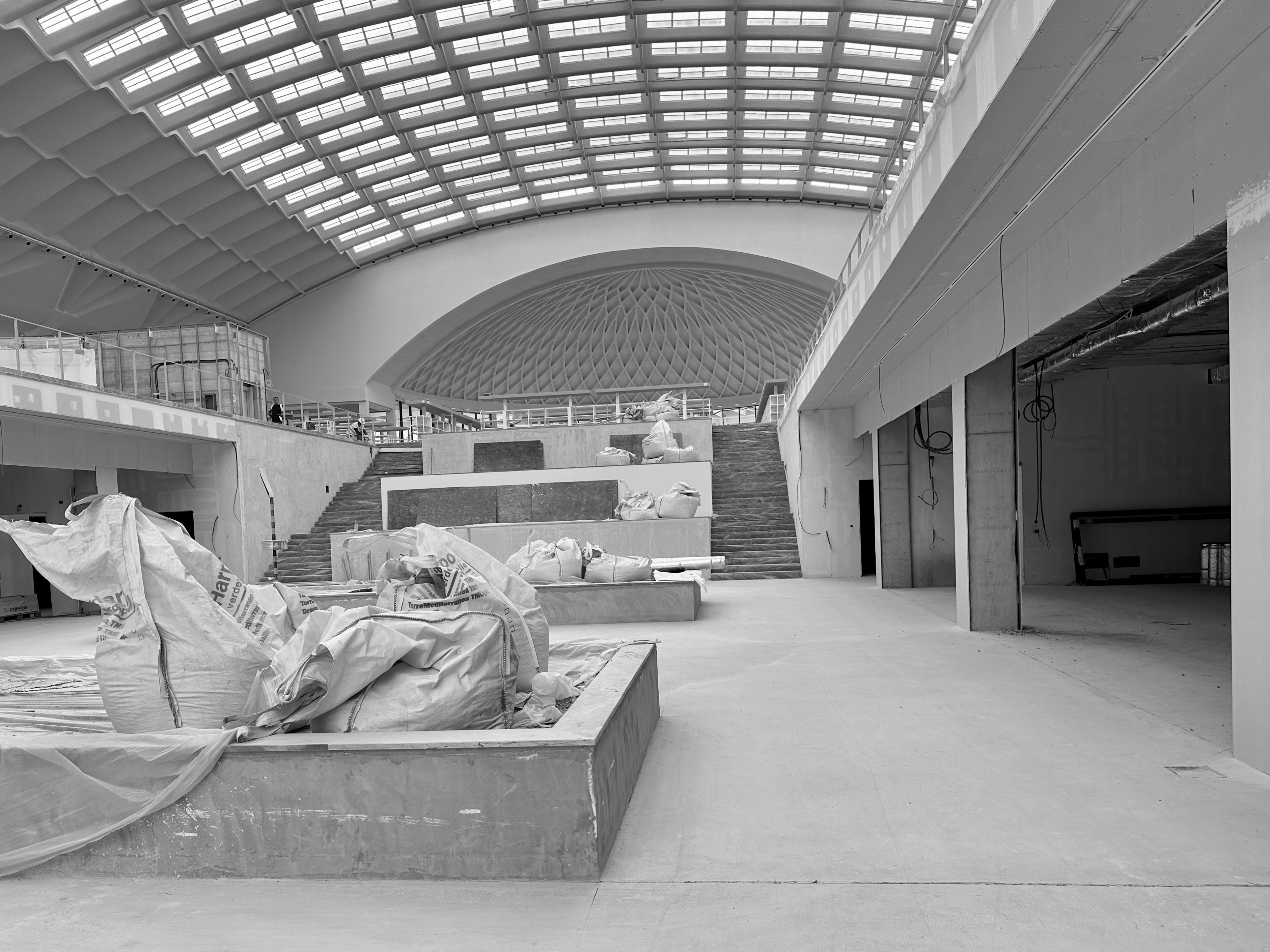
I spent this week at the annual conference of the International Association for Shell and Spatial Structures, presenting some spinoff Nervi work in sessions on shell history and archives. The conference was in Turin, Italy a longtime favorite city for many reasons, not least of which is that it contains some of Nervi’s most important work. As “Italy’s Detroit,” Turin not only built all sorts of industrial buildings, some of them by Nervi. It also regularly hosted auto shows, highlighting its local manufacturers–particularly Fiat.
In 1947, Turin decided to host that year’s International Automotive Exposition, despite the fact that its exposition buildng–like much of the city–had been bombed flat in the Second World War. Nervi, famously, was the sole bidder on a project to construct a new one. Italy’s other engineers and contractors were scared off by an eight-month construction schedule that seemed not just impossible, but superhuman. Nervi e Bartoli were able to design, fabricate, and build it on time, however, due to their prefabrication process and a construction sequence that eschewed large cranes in favor of smaller elements and human-powered winches.
I’ve blogged about that process and the results before here, along with a lament that the building had long been underused and ill-maintained. Several years ago, however, Turin decided to embark on an adaptive reuse project that sounded too good to be true–turning Nervi’s Salone B into a city library and hiring Rafael Moneo’s office to design it. Moneo, known for sensitively weaving new functions into historic–occasionally Roman–building fabric, seemed an inspired choice.
After a generous invitation to tour the nearly-completed project, I can report that the results exceed any Nervi fan’s wildest expectations. The structure and its ancillary spaces received a comprehensive analysis and restoration, thanks in part to a conservation plan funded by the Getty and a small army of dedicated Italian architects and engineers, and much of the work of redeveloping it as a library went to addressing issues–roofing and waterproofing, environmental control, and seismic upgrades–that could only be funded with a suitably massive civic project.
The main space looks spectacular; Moneo’s major intervention was to add mechanical and storage space in a new basement (most of the original was slab-on-grade to save construction time), and to open up a new, sunken reading room within the main space. While this changes the purity of the original space, it also offers new views of Nervi’s “wave ashlar” roof, a finely scaled, broad-spanning structure fabricated and hoisted into place piece by piece. Moneo’s office limited the height of new shelving on the main floor and in the ‘aisles’ to ensure none of the vast space feels too partitioned, and the entire structure has received a cleaning and a new palette of matte white paint that emphasizes the roof’s lightness and structural texture.
It’s a phenomenal achievement, and when it formally opens in December, it will be proof that the investment in transforming “obsolete” structures, especially early postwar ones, can pay off in civic monuments that dialogue with, rather than replace, the past. But this one also provided a template for how conservation science, creative architectural design, and sensitive engineering solutions can all work together to make that process both more robust and more cost-effective. Turin will have an inspiring library, and a structure that speaks clearly to a moment of recovery and rebirth in its own past.
Nervi’s other works–many of which are under serious threat from either neglect (the same city’s Palazzo Lavoro) or ill-considered additions (Florence’s Stadio Franchi and Rome’s Stadio Flaminio) have another model showing how conservation and re-imagining can co-exist. Salone B will add to the recent, successful renovation of Rome’s Palazzetto dello Sport. We can only hope for more good news–Turin has set a high but achievable bar for itself and for other cities that have such a success story waiting to happen in their midst.
Many thanks to Elisabetta Margiotta Nervi, Cristiana Chiorino, Irene Matteini, Erica Lenticchia, and Francesco Romeo.
Espresso machines are standard eqiupment in Italian jobsite trailers. I see no problem with this.
CHSA Mexico City had many highlights, but one bucket-list item for many of us was seeing this adorable piece of concrete-shell construction on UNAM’s campus. I’ve used Felix Candela’s Cosmic Ray Pavilion to introduce students to shell principles for well over 20 years, so seeing it in person was a much-anticipated stop on our campus tour.
Candela was commissioned in 1951 to design and build the pavilion to house sensitive equipment used to detect incoming cosmic rays, high-energy particles that would have been absorbed by heavy building materials. For their experiments to work, the researchers required the pavilion roof to weigh less than 8 pounds per square foot. This would have been achievable in aluminum, but at a high cost, or in timber, which would not have been permanent enough. Traditional concrete would have been way too heavy, but Candela, by this point, understood how to use doubly-curved geometry to create shell structures—forms that, because of their shape, funneled stresses along their surfaces rather than relying on the depth and mass of girders or slabs to sustain loading.
Felix Candela, 1957. Section taken through one of the stiffening ribs, so a bit misleading re: thinness of the concrete roof.
The pavilion isn’t particularly big—just about 33’ square—but a traditional beam-and-slab system spanning that far would need to be about a foot deep—far too much material. From the outside, Candela’s basic structural solution is obvious. The parabolic shape in cross section is close enough to a true catenary that the dead weight of the roof is carried almost entirely through compression within the shell itself. Thin members in compression, though, risk buckling, so Candela also gently curved the shell in the lateral direction, giving it resistance to that force perpendicular to the parabola. You can just barely see this from the sides—the crown of the roof looks like it’s sagging—this secondary curvature tracks over the roof’s summit.
The double curvature creates a stiff shell structure—one that can only change shape if the material itself fails. Changing an eggshell’s shape requires crushing it, and for the Pavilion’s roof to change shape, it would have to crack. If the secondary curvature wasn’t there, the roof could simply unfold.[1] In Candela’s words:
“Any shape that can be formed by bending or folding a piece of paper cannot be considered a shell, because the shape is not really stable. You can bend a piece of paper, unbend it and it becomes flat again. Therefore, stability of form depends either on the flexural strength of the material or on some outside element of support. But, if one has a double chord surface, such as a dome, made of any unextensible material, it cannot be made flat again unless the material is completely destroyed.”[2]
So, ideal structural shape, but complex. Candela’s real genius was that he was a builder as well as an engineer, and he could translate another mathematical idea into concrete using widely available lumber and relatively unskilled labor. Ruled surfaces are generated by straight lines (generatrices) that connect points on two out-of-plane axes (directrices). The gradually changing three-dimensional angles of these lines produce surfaces that naturally have curvature in two directions, guaranteeing that they will be what Candela termed “lamina,” or shells. What Candela realized was that straight pieces of lumber could translate the “rulers” of these surfaces from abstract mathematics into, well, concrete construction.
From Banham, “Concrete: Simple Vaulting Practices,” 1953
By laying out grids of long, thin pieces of wood in gradually transforming angular forms, Candela created formwork onto which concrete could be placed and troweled, creating a doubly curved shape without the complex carpentry necessary to form, say, a perfectly hemispherical dome. Here, Candela used two layers of straight lumber—one of 2x4s providing structural support for another of tongue-in-groove, flat elements at a 60° angle to it. The few construction photographs of the result have their own geometrical beauty, but they also show how simple the woodwork was. Three arches stiffen the shell and are connected to crossbeams and arches that lift it off the ground. This provides a ‘front door’ beneath, reached by a stair cantilevered from a single central stalk. (Locked, despite our best efforts…)
From María González Pendás, “Bodily Economies of Concrete Technologies.” Positions on Shell Construction: Candela, Isler, Müther, 2020.
So, a shape that is both structurally and constructionally efficient—but Candela brought the entire idea back around, noting that the mathematics of ruled surfaces allowed for “the feasibility of making accurate calculations quickly.” He wrote that his own engineering abilities were limited, and that he lacked the computing power and time necessary to analyze complex shells. This family of shapes—infinite in number but restricted by their reliance on straight-line generators and directors—reduced the mathematics involved to “a very simple equation of the second degree (one of the quadrics)….[with] only three co-ordinates and a single constant.”
Elsewhere, Candela emphasized that, as compelling as his doubly curved surfaces were, they relied on simple ideas. “’It is better to use simpler procedures which, in most cases, are sufficient when the designer is a constructor.”[3] But the discipline to achieve that simplicity also, in Candela’s mind, offered a ready-made source of beauty:
“A shell cannot be drawn by hand with a happy pencil. On the contrary, one must have a very close geometrical surface or form. This is a very good discipline because, if one is guided by geometry, it is probable that the structure will look attractive. It is one of the amazing properties of this surface that it is extremely difficult to do ugly things with it. A kind of automatic beauty is achieved . . . somewhat similar to design by computer. This is a very interesting proposition for architects.”[4]
Indeed.
[1] See Tyler S. Sprague, “Beauty, Versatility, Practicality”: The Rise of Hyperbolic Paraboloids in Post-war America.” Construction History, vol. 28, no. 1. 2013. 165-184
[2] Felix Candela, “Shell Structure Development.” The Canadian Architect, vol. 12, no. 1. Jan., 1967. 33.
[3] Quoted in Reyner Banham, “Concrete: Simplified Vaulting Practices.” The Architectural Review, vol. 114, no. 684. Sep 1, 1953. 199,
Returning home from a stellar few days at UNAM in Mexico City, where the Construction History Society of America held its 10th regular meeting as part of a bi-national event with the newly formed Mexican society, which announced its founding as part of our closing ceremonies.
When CHSA started in 2007, we debated whether the right term was “of America” or “of the Americas,” and this week was clear evidence that the boundaries between largely English-language work north of the Rio Grande and largely Spanish-speaking scholarship south of it are at once important and permeable. With simultaneous translation available on any mobile phone, being able to present and understand in multiple languages has enriched events like this, making more scholarship available to those of us who aren’t multi-lingual, and provided broader audiences for those who aren’t working in a discipline’s lingua franca.
All of which is to say that it was a real joy to hear about a modernist baseball stadium in Oaxaca, or the use of iron in Guastavino vaults in Jefferson’s Rotunda (!) delivered in scholars’ native languages and be able to follow along. The conference’s chronological range matched its geographical reach, with good papers on 16th century vaulting in central America, the selling and lived experience of Chicago skyscrapers in the 1890s, and the design and expansion of UNAM itself, reflecting the huge range that Construction History encompasses, and the enthusiasm its practitioners have for seeing some of our basic principles applied across time and space.
That UNAM paper was particularly fascinating, since the campus itself (one of two educational precincts in the Americas designated a UNESCO site, along with UVA) is an incredible collection of ambitious postwar design, from the famous mosaic-clad library tower to the football (yes, football) stadium that hosted track and field events for the 1968 Olympics. The welcome there, thanks to our UNAM hosts and a small army of student volunteers, was particularly warm, a day-long group bus tour of Teotihuacan was jaw-dropping, and the food was stellar. Hoping to be back soon.
In the meantime, the next big Construction History event will be the next International Congress in Turin in June, 2027. Want to join that good looking group above? Submit an abstract! There are still three weeks before the submittal deadline, and there’s a particularly good session on the history of Vertical Urbanism (subtle), more information here…
How do you combine an accreditation-required Integrated Design Studio with curricular requirements for a high-rise project and a general interest among students in adaptive reuse? You Frankenstein a program together with some help from ace professionals with connections and their own ideas for recycling historic buildings into economically viable, culturally and socially relevant additions to downtown.
William LeBaron Jenney’s Second Leiter (also Siegel-Cooper) Store is a massive, half-block structure that served as a department store for the first chapters of its life, and was then carved up into academic facilities for Robert Morris University in 1998. When RMU merged with Roosevelt University several years ago, the building was mothballed, leaving something like 440,000 square feet of space in a prime Loop location vacant.
Aditya Bhave& Himanshi Rathod
What to do with that much space? Unlikely in this development climate that it could work as commercial office space, so working with Ken DeMuth of Pappageorge Haymes and Kim Clawson of WJE, we developed a program for academic and dormitory space for the Loop’s “Seven Colleges,” small liberal-arts or professional schools that looked at developing a shared “University Center” about ten years ago (some survivors may remember that this accidentally turned into a “Chicago’s Tallest Building” studio for a graduate class at Iowa State…). We added the adjacent corner site, at Wabash and Van Buren, and proposed about 1.3 million square feet of residential and academic facilities, which could be distributed between the existing structure and a new, corner tower.
Sneha Rajendran & Keith Reinhard
The catch, of course, is that the Leiter Building’s floor plates are massive–and too deep to easily adapt to apartment or dormitory functions. But its column grid–varying, but around 22′ square–doesn’t leave much room for the large classrooms that the program required. So students had to think not only about replanning the building’s floor plates; they also had to make value judgments about how much to alter the existing structure to make the program work, and/or whether to do the hard structural work of building a high-rise tower atop a bunch of long-span classrooms.
After a stellar field trip in January, where we got to tour the existing building and see newly-archived original drawings from Jenney’s office, students got to work on the Jenga-like massing studies required to fit rectangular pegs into (differently-sized) rectangular holes, all the while thinking about what it meant to build within and adjacent to a classic Chicago School building. We did exercises tracing the building’s elevations (Ken, Kim, and I have a working theory about its odd proportions and how tall it was really supposed to be…) and looking at materials and composition strategies from other 1890s buildings in the Loop. And, since it was an Integrated Design Studio, teams spent the time to figure out exiting strategies, mechanical system layouts, and cladding details.
This cohort of graduates will likely spend half their professoinal careers working on existing buildings–if not more. Giving them the experience of the constraints and inspirations that the process brings with it has become an important part of our studio teaching at Illinois, and this program and site nicely balanced their understandable desire to design something “new” with the guiderails of a rigorous column grid and a building fabric that they had to treat as a ‘ready-made.’
Karina Espana and Dylan Becker
Teams came up with genuinely innovative ideas, either carving light courts and multi-bay voids into the existing building’s grid or, in one case, slicing the outer bays out of the building to leave the facade standing as a screen shading a covered collonnade/balcony space for retail and residential units behind. As the tower schemes developed, we also talked about the importance of a presence on Chicago’s skyline, and how sculpting architectural solutions into civically relevant forms was another dimension of the city’s skyscraper heritage.
Yogitha Reddi and Sayeda Rudaba
Most of these folks are freshly graduated and in the first weeks of their careers…a great bunch to work with, and I’m looking forward to seeing how they take this experience into practice. Thanks to everyone who supported the studio, including Nathaniel Parks, the Tigerman McCurry Director of the Art Institute of Chicago Archives Research Center, who alerted us to the drawing tranche there and generously provided access, and to Rachel Will of WJE who rode shotgun as we mulled over how to develop the program. Finally, huge thanks to Tom Liravongsa, Instagram and YouTube’s “Skyscraper Guy,” for providing access to the Leiter Building.
A couple of Skyscraper Guys hanging out on top of a WLeBJ groundscraper back in January.
“Ask anyone conversant with urban problems to tick off the names of private builders who are devoting their efforts to building ‘a better civic civilization’ through urban redevelopment, for example, and chances are he could do it on the fingers of one hand. And it is a safe bet that one of the names mentioned would be that of ‘Herb’ Greenwald.”
David Carlson, “City Builder Greenwald.” Architectural Forum, May, 1958. 118.
Herbert Greenwald’s internship in Holsman’s office quickly turned into a partnership. After briefly quitting real estate to teach at Hebrew schools in Chicago during WWII, Greenwald returned to the firm with a collaborative effort; Sherman Garden Apartments in Evanston. Constructed in 1946 at the intersection of Sherman Avenue and Emerson Street near the Northwestern campus, this development included 132 apartments in three seven-story blocks surrounding a courtyard.
Holsman, Holsman, Klekamp, and Taylor were the architects, and the buildings were clear relatives of the Holsman organization’s contemporaneous developments—Lunt-Lake in particular—with curving windows, efficient planning, and many of the construction innovations that had made previous projects efficient but comfortable. Greenwald, listed as “Agent for the Trust,” led the project, but D. Coder Taylor, of the Holsman firm, was listed as an actual Managing Trustee.[1] Given that, Sherman Garden Apartments was a tentative first step by Greenwald toward his own career as a developer and builder.
from Sherman Garden Apartments: Better Living Through Mutual Ownership. (Evanston: Wallace and Orth Sales and Management Agents, 1946).
His next step, however, was ambitious—and history-making. Greenwald formed his own development corporation—Metropolitan Structures—and a related construction company—Herbert Construction. The pairing was very much in line with Holsman’s model, and Greenwald stated his goals in much the same terms as Holsman had articulated his. Covering his meteoric rise a decade later, Architectural Forum described his approach as “making civic humanism pay,” that is, applying the values he had learned under Mortimer Adler and at the Holsman firm to development projects that would at once address Chicago’s housing shortages—and earn a reasonable profit. To do this, he would rely on the Holmsans—particularly Henry’s son John, who had taken over much of the development arm of the organization. But he would expand his sights to larger projects and even more innovative architects.
In 1946, Greenwald convinced local Chevrolet dealer Samuel Katzin to invest in a plot of land on the lakefront in Hyde Park. The two had met through Jewish philanthropies, and Katzin had been impressed with Greenwald’s plan. The site was close enough to the University of Chicago that, like Sherman Garden Apartments, it would have a natural constituency among faculty. But it was also highly visible and, with views over the lake, an ideal location for a high-rise apartment building.
Greenwald’s initial queries to architects were charmingly innocent; after Eero Saarinen turned him down and Frank Lloyd Wright agreed—for a fee of $1,000,000—Walter Gropius responded to Greenwald by pointing out that “the father of us all,” Mies van der Rohe, was literally just up the street. Mies, who had yet to design a high-rise that was built, was keen to come on board, but Greenwald also hired Charles Genther, a former Holabird and Root employee who had assembled PACE Architects out of fellow H&R alumni, as architect of record—and Holsman, Holsman, Klekamp, and Taylor as mechanical engineering and financial consultants.
Promontory Apartments, Hyde Park, Chicago. Mies van der Rohe, PACE Associates, and Holsman, Holsman, Klekamp, and Taylor, collaborating architects, 1949. From “Glass and Brick in a Concrete Frame,” Architectural Forum, January, 1950.
Promontory was developed along exactly the same lines as Sherman Gardens and the Holsman’s concurrent developments—as a Mutual Ownership Trust. As groundbreaking as Mies’ design was, Architectural Forum dedicated as much space to its financial arrangements as its architecture, describing these succinctly and, as it would turn out, presciently:
“Most co-ops are tax-conscious devices where the promoter leaves the tenants on their own after the building is built. Mutual Trust, on the other hand, provides for promoter responsibility during the whole life of the building. Tenants buy a trust certificate representing their share in the building, but they do not run it. The promoter sets up a board of trustees, usually including himself, to do the job. Perhaps the most compelling proof of the promoter’s responsibility under mutual trust is that he and the other trustees are fully liable in the event of financial difficulty. (Tenant liability, on the other hand, is limited to their original equity investment).”[2]
Two versions of 860-880 Lake Shore Drive: as built (top), and as drawn by Mies van der Rohe. Architectural Forum, January, 1950, and Archeyes.com.
Holsman, Holsman, Klekamp, and Taylor played the same role in 860-880 Lake Shore Drive, which was also financed on the Mutual Ownership Trust plan and completed in 1952. Notably, Mies’ planning for the units in 860-880 was rejected by Greenwald under pressure from lenders for its lack of partitions between bedroom and living room spaces and for exposing those bedroom areas in the building’s corners. As built, the apartments’ plans are more traditional—and they bear more than a passing resemblance to many of the planning tactics used by the Holsmans in their contemporary projects. PACE certainly also had input on these, as the architects of record here, as they had been on Promontory, but a comparison between Holsman’s plans for Lunt-Lake and 860-880—both published in the same issue of Architectural Forum in 1950.[3]
Algonquin Apartments, Hyde Park, Chicago. Mies van der Rohe*, PACE Associates, and Holsman, Holsman, Klekamp, and Taylor, 1950-51. (Photo by the author, from Chicago Skyscrapers, 1934-1986.)
Mies, Greenwald, PACE, and Holsman’s firm collaborated on at least two other projects in 1950-52. The Algonquin Apartments in Hyde Park (1950-51) are the better-known of these, though Mies so strongly objected to the inclusion of ground-floor units in these six towers that he had his name removed from the project. More intriguing was the same group’s proposal for a 10-story office building at Rush and Huron in 1948, “the most functional and severely plain office building in the Midwest,” according to John Holsman. Designed by Mies, the project was to have radiant concrete structural elements, just like those in Holsman’s residential developments, and to be funded by commercial tenants.[4]
Rush and Huron Office Building (unbuilt). Mies van der Rohe, PACE Associates, and Holsman, Holsman, Klekamp, and Taylor, 1948. From Al Chase, “Plan Chicago’s First Big Co-Op Office Building: Rush-Huron Project to Cost $1,300,000.” Chicago Daily Tribune, Sept. 12, 1948. 1-nA.
In 1951, the Holsmans—on their own—proposed a 12-story tower that placed ten floors of apartments atop a podium of shops and offices. In addition to mixing commercial and residential uses—a radical idea at the time—the design, for the site of the McCormick Mansion at Rush and Erie streets, was to have “skip-stop” elevators, reducing the need for corridors by having tenants walk up or down one floor from elevator landings to their apartments.[5]
100 E. Erie St., Chicago (unbuilt). Holsman, Holsman, Klekamp, and Taylor, 1951. From John Hancock Callendar, “Apartment Houses: Architectural Record’s Building Types Study #181.” Architectural Record, Dec., 1951. 145.
Neither of these last two projects was built. The brief 1948-50 recession, coupled with the restrictions that accompanied the onset of the Korean War in 1950, seriously affected the Holsman model. Contractors could not readily obtain construction materials, in particular steel, without going through a lengthy, unpredictable application process after the outbreak of hostilities and the passage of the Defense Production Act in September of that year.
William T. Holsman later testified that a single contractor’s default on an unnamed project (likely Parkway Gardens) triggered a cascading financial crisis within the Holsman organization; after an FHA commissioner refused to reassign the work, the Holsman trust faced delays that threatened the project. Future residents had already invested in that project’s trust, and the Holsmans had to move money from other trusts to cover their losses.[6] This skirted legality, but when the firm was unable to proceed with a planned third phase of the Winchester-Hood project, investors and prosecutors pounced.
Winchester-Hood Apartments under construction, 1952. From “Mutual Ownership Apartments: How They Were Financed by a Chicago Group.” American Builder, vol. 74, no. 8. Aug. 1, 1952. 87.
While Henry and William Holsman both made convincing defenses that this was simply a business failure, the fact that nearly $250,000 of the Winchester-Hood Trust’s funds had already been spent on architects’ fees—to Holsman, Holsman, Klekamp, and Taylor—and that just $190 remained in the Trust’s accounts made for terrible optics. In February, 1955, father and son were indicted on federal securities and mail fraud charges; they were convicted in January, 1956 of defrauding 124 prospective residents out of $677,387 and sentenced to four years in prison each.[7]
Ultimately, the younger Holsman’s sentence was reduced to three years by a District Court judge who noted that the Holsmans hadn’t actually profited from the debacle. The same judge, apparently disgusted with the lower court’s verdict, reduced the elder Holsman’s sentence to a single hour, citing his advanced age.[8] Henry K. Holsman died in 1961, at the age of 94, in Lake Genoa Wisconsin.[9] After serving his time, William T. Holsman and his brother practiced around Lake Geneva and Delevan, Wisconsin.
Commonwealth Promenade Apartments, Chicago, IL. Mies van der Rohe and Friedman, Alschuler, and Sincere, 1957. (Photo by the author, from Chicago Skyscrapers, 1934-1986.)
The later developments by Greenwald and Mies—Commonwealth Promenade, Esplanade, and 2400 Lakeview—were all designed after the Holsman bankruptcies and, thus, with other firms. Genther and Mies parted ways as well, particularly after a falling out over the competition for Chicago’s Federal Center competition in 1959. Greenwald would perish in a plane crash in February of that year, in the midst of projects for apartment developments that combined Mies’s designs with Holsman’s mutual ownership plans in Detroit, Newark, San Francisco, and Baltimore, only some of which survived his passing.[10]
The Holsman’s downfall revealed a major flaw in Mutual Ownership: the significant and ongoing risk that each trust’s management took in accepting residents’ funds before construction and acting as a fiduciary while managing the project. Fewer developers were willing to take this on. In 1963, Illinois passed legislation enabling condominium ownership—essentially removing the requirement for property to be tied to an actual piece of land. While co-ops continued to be organized, condominiums offered developers a shorter period of liability and vulnerability, requiring only repayment of construction loans and mortgages. This allowed them to get in and out of projects quickly, and the type spread throughout the city, in high-rises on the lakeshore to low-rise developments throughout Chicago.
Herbert Greenwald and Mies van der Rohe. From David Carlson, “City Builder Greenwald.” Architectural Forum, May, 1958. 118-119.
Interviewed by Architectural Forum just months before his death, Greenwald avoided mentioning Holsman—understandable given the stigma attached to his recent conviction. But just two years prior, he had paid, perhaps, a silent tribute to the inventor, architect, and developer who had been his mentor and partner. Invited to a panel on multifamily housing construction at the Drake Hotel in April, 1957, Greenwald lamented the state of building technology as a major reason for Chicago’s ongoing housing shortage. “Because of a 20-year lag in construction,” he told the audience, “we don’t have a window in an apartment as good as in a car or airplane.”[11] Holsman, of course, had worked on exactly this, taking the expertise gleaned from a short but productive automotive career and translating it to the architectural world.
[1]Sherman Garden Apartments: Better Living Through Mutual Ownership. (Evanston: Wallace and Orth Sales and Management Agents, 1946).
[2] “The Financing of Promontory.” Architectural Forum, Vol. 92, no. 1. Jan., 1950. 77-78, 124.
[3] “Glass in a Steel Frame,” and “Pioneering Construction Ideas,” Architectural Forum, Vol. 92, no. 1. Jan., 1950. 76-77, 81.
[4] Al Chase, “Plan Chicago’s First Big Co-Op Office Building: Rush-Huron Project to Cost $1,300,000.” Chicago Daily Tribune, Sept. 12, 1948. 1-nA.
[5] Al Chase, “Big Apartment House to Have Skip-Stop Lift: Site That of Cyrus McCormick Home.” Chicago Daily Tribune, May 19, 1951. 1-b5.
[6] “Chicago Firm Links FHA Aid to Bankruptcy: Architect Criticizes Powell’s Rulings.” Chicago Daily Tribune, Apr. 22, 1954. 2.
[7] “Son, Father, 89, Convicted Of Defrauding 124: W. T. Holsman, 50, Gets 4 Year Term.” Chicago Daily Tribune, Jan. 20, 1956. 10.
[8] “Sentenced To 60 Minutes in $667,387 Fraud.” Chicago Daily Tribune, Feb. 21, 1956. 12.
[9] “Holsman, Noted Designer, Dies in Genoa City.” Lake Geneva (Wis.) Regional News, May 25, 1961. 19.
[10] “Herbert S. Greenwald.” The New York Times, Feb. 5, 1959. 22.
[11] Ernest Fuller, “Urge More Research in Construction.” Chicago Daily Tribune, Apr. 21, 1957. A7.
In August, 1949, a team of seventeen building industry professionals from Great Britain toured the United States, seeking American “know-how” to help their home country rebuild after WWII. Under the auspices of the “Anglo-American Council on Productivity,” a spinoff from the Marshall Plan, the group toured seven U.S. cities, observing federal projects in Washington, the United Nations Building under construction in New York, and various housing developments throughout the country. It was in Chicago, however, that they found “the only completely modern things” being built in America.[i]
Those modern buildings were a new round of Mutual Ownership projects being designed, financed, and constructed by the Holsman organization. Henry K. Holsman, now in his early 80s, was in the midst of a renewed career in the heated postwar housing market. After a run of successful co-ops in Hyde Park and South Shore, he and his sons had expanded their vision, finding sites for development throughout Chicago and its suburbs. New sites in Grand Crossing, Rogers Park, Evanston, and River Forest proved fertile territory for Holsman’s clever re-working of cooperative financing arrangements; he found eager markets of middle-class residents seeking the benefits of home ownership in dense urban settings far beyond Hyde Park.
Lunt-Lake Apartments, Chicago, IL. Holsman, Holsman, Klekamp, & Taylor, 1948-50. Plan of typical four-story walkup wing. From Architectural Record, Sept., 1950.
Holsman’s designs, too, evolved in this era. His earlier projects, whether mid- or high-rise, had adopted a standard developer’s classicism, using red brick and terra cotta to blend with surrounding traditional houses and apartment buildings. But with this generation of buildings, he and his design team adopted a moderne style that expressed simple planes of brick accented by trademark windows that gently curved outward, and a Scandinavian-influenced approach to interiors that opened living areas to one another.
It was the construction of these, however, that the British team found strikingly new. “The walls were built differently,” one of the touring architects told Architectural Forum.
“The floors were laid differently; the wiring was run differently; the heating was designed differently; the windows were framed differently; the ceiling[s] were finished differently; even the grading was done differently. In fact, so many things were done differently that it might be shorter to list their points of similarity than their points of difference from the usual garden apartment.”[ii]
Mutual Ownership, Holsman explained, naturally emphasized innovation in construction. Typical co-op developers walked away from a project once it had been built and sold, leaving the group of owners responsible for the building’s maintenance and repair. Those developers were, therefore, incentivized to build quickly and cheaply. Because his organization took responsibility for operating and maintaining each “Trust” after its buildings were completed, though, Holsman had an interest in the quality and durability of the finished product, too, leading him and his team to search for methods and materials that could combine rapid, inexpensive construction with long-term performance. The construction sites and finished buildings that the British team toured, therefore, were full of innovative techniques that Holsman either pioneered or refined.
Among these were left-in-place joist pans, similar to those he had used on the 1934 Model Country House at the Century of Progress Exhibition. These pans were fabricated with integral reinforcing bars, welded to bulkhead plates at their ends, which eliminated the time-consuming placement of rebar in situ. Once these were placed, precast floor slabs were laid on top of them, pipes for radiant heating and conduit for electrical outlets were woven between them, and a single pour of concrete filled the pans, locked the slabs to one another, and provided a leveling top layer that could be rapidly squeegeed to provide a smooth floor finish.[iii]
Winchester-Hood Apartments I, Holsman, Holsman, Klekamp, & Taylor, 1949-51. Installation of steel joist pans (l) and precast flooring slabs (r). From “Mutual Ownership Apartments: How One Builder Held Costs to a Minimum.” American Builder, vol. 74, no. 9. Sept. 1, 1952. 145.
The resulting floor was just 3” thick, supported by joists that took up only 8” of space, on 3’-0” centers. Exposing these in the space below, as he had done in his earlier projects, allowed Holsman to achieve 8’-1” ceiling heights throughout most of the resulting apartments with just an 8’-4” floor-to-floor height. Combined with his earlier “English basement” technique, which buried the first-floor apartments halfway into the ground, these projects could provide four floors of residential accommodation with staircases of just 43 steps. “You can’t find a conventional apartment in Chicago where the walk up to the third floor isn’t more than that,” he told Forum.[iv]
Holsman explained that these sectional efficiencies alone made his approach more affordable than any conventional construction, gaining 33% more floor space for the same volume and avoiding the need for elevators in the resulting four-story structures. But he also innovated in these projects’ masonry walls, developing a reinforced, rowlock method of brick construction that relied on a central core of poured concrete to achieve adequate structure for four floors in walls that were just 8” thick. Windows were framed in precast concrete units, which served as jigs for the surrounding brickwork, eliminating the need for precise coordination during bricklaying. Inside, Holsman adapted the prefabricated stair design he had developed for the Cabrini Row Houses, again speeding construction while guaranteeing quality. Together, Holsman claimed that these innovations allowed him to build apartments for $1500 per room and to run them for $50 per room per month ($20,000 and $740 in 2026 dollars), about 17% less than typical construction and almost 40% less than market operating costs.[v] These innovations enabled projects like the 88-unit Lunt-Lake Apartments (1946-48) and Winchester-Hood (1949-1951).
Parkway Gardens, South Martin Luther King Dr., Chicago. Holsman, Holsman, Klekamp, & Taylor, architects. Photographer unknown.
Among these projects, Parkway Gardens, at 6330-6546 South Dr. Martin Luther King Jr. Drive, stands out as both an exemplar of Holsman’s techniques and the ends to which they were directed. Financed by a local waiter’s union whose members were frustrated with the discriminatory housing market in Chicago, the project was announced in early 1950 and constructed over the next two years on the site of the derelict White City amusement park. The Holsmans were hired as experts in Mutual Ownership, and together with a board of local, Black businessmen, the project was financed with mortgages insured by the Federal Housing Authority. Holsman laid out 24 walkup buildings on gentle diagonals, surrounding 11 eight-story elevator buildings, all of them using techniques from the organization’s growing toolbox. Nearly 700 units of five or six rooms each were planned throughout, with a target rental of $21 to $41 per month ($288 to $561 in 2026 dollars) after initial investments of $2500 per unit ($34,500).[vi] The project’s initial impulse, to provide “modern, comfortable homes for waiters and their families,” became the largest mutual ownership project in the nation and one of the largest and most successful efforts by the private sector to provide quality housing for Black families. Civil Rights leader Mary McLeod Bethune, after attending the complex’s opening, wrote in the Defender that
“…our vision and our pocketbooks, stimulated by our great need, have found a meeting place, at last. It means that another lesson has been learned in security through unity.
“We have learned to recognize the mutual ownership of housing as an important forward step, much more important, possibly, as a measure of group advancement, than the occasional acquisition of princely mansions by individuals.”[vii]
Holsman and Holsman, Architects, were named to the Chicago Defender’s “Honor Roll” in 1950 for “developing a mutual ownership housing plan which enables low-income groups to provide themselves with decent housing, and particularly for their role in the construction of Chicago’s Parkway Gardens Homes,” along with local and national figures who had championed integration.[viii] Parkway Gardens would become the childhood home of Michelle Obama, among many others.[ix]
Parkway Gardens, ca. 2018.
Holsman would deserve recognition for all of this alone, but he was most important to Chicago’s architectural history as a mentor and financing consultant. In the 1930s, he hired a young University of Chicago student for a part-time internship. That intern, originally from St. Louis, had attended Yeshiva University in New York but, after a change of heart, had come to Chicago to study in Mortimer Adler’s Great Books program. Put to work on the River Forest Garden Apartments project, the new hire clearly picked up both Holsman’s interest in advanced building techniques and his mission to yoke these to a grander civic vision. Years later, after that intern emerged from Holsman’s organization as a developer himself, one of his collaborating architects would say that he “began with an idea of the social consequences of his work,” and “discovered along the way that he was also a very good business man.”
That architect? Mies van der Rohe. And that young protégé of Holsman? Herbert Greenwald.
[iii] Robert W, Glasgow, “Unusual Design Features Produce Savings in Chicago Apartments.” New York Herald Tribune, Nov 6, 1949. D5; See, too, Henry T. Holsman, US Patent # US3059380A, “Block Wall Reinforcement,” granted Oct. 23, 1962.
[v] Clayton Kirkpatrick, “Expect Most Building Since Boom Of 1926.” Chicago Daily Tribune, Jan 12, 1947. A7.
[vi] “Parkway Garden Homes.” National Register of Historic Places Registration Form, certified Oct. 11, 2011.
[vii] Mary Mcleod Bethune, “Chicago’s Parkway Gardens Symbol Of Growing Economic Unity And Strength.” The Chicago Defender, Oct 28, 1950. 6.
[viii] “Eight Of Outstanding Americans On Defender 1950 Honor Roll.” The Chicago Defender, Jan 6, 1951. 1.
[ix] “Parkway Gardens Apartments: A New Idea in a New Era.” Chicago Defender, Oct. 7, 1950. 23. Parkway Gardens suffered a long decline after its ownership changed, first to the federal government in the 1970s and eventually to profit-minded developers who failed to invest in maintenance and repairs.
Holsman’s low-rise forays into the Hyde Park and South Shore neighborhoods were successful enough that he moved on to taller buildings: an eight-story building containing fourteen apartments at 5617 Dorchester (1928),[i] and a fourteen-story tower with twelve apartments, each taking up a whole floor, around the corner at 1321 E. 56th Street (1929-30).[ii] The taller structure on 56th was planned with “sky playgrounds” for children on the upper floors, and what was becoming a trademark for Holsman’s developments, an “English basement,” or split-level first floor that provided privacy for the first story of residences and easy access from the street for boilers and service rooms below. Holsman argued for higher quality in these buildings—neither was a “shirtfront affair,” according to contemporary press accounts, meaning that they were designed with face brick and stone ornament on all four sides, not just the street fronts. Because residents had financial stakes in the buildings, he suggested, they were willing to see such improvements as investments. Developers of traditional rentals had no such incentives; as commodity housing, their projects emphasized cost over value. Co-ops, or “Mutual Ownership,” in Holsman’s words, not only democratized equity; they also encouraged better building.
That distinction in terms proved important when the Depression hit. Traditional co-ops had no out clauses; if a shareholder went bankrupt, the remaining co-operative was on the hook for their annual rent. Holsman’s arrangements were subtly different. His real estate firm, Parker, Holsman, Leigh, Inc., actively managed these buildings, and non-payment of the monthly rents terminated a shareholder’s rights to their unit. Other owners were spared both the cost of absorbing the obligations of bankrupted residents and the awkward, fraught legal process of ejecting a one-time neighbor from their homes. After the 1929 crash, co-ops throughout the city suffered huge defections and failures. The eight Mutual Ownership projects that Holsman had built by then, however, remained solvent. “Not one person in these eight buildings in eight years has taken a loss on account of such investment,” Holsman told the Tribune in November 1931.[iii]
By that point, though, his market had been fairly safe. All of these developments were in the relatively stable environs of the University of Chicago, within a mile or two of campus and—if not immune to the financial crisis enveloping Chicago and the world, at least not as volatile as other parts of town more directly impacted by the stock market or the Depression’s crushing losses in manufacturing. Holsman’s focus gradually shifted; he and his design and development companies sought ways to use the technical innovation he brought from his automotive experience to address the growing housing crisis in Chicago.
He had a bully pulpit that allowed him to publicize the cause of good housing. As former president of the Illinois AIA, he was a familiar name to the profession, and he lectured widely on the need for modern developments to house not only Chicago’s population—which grew explosively as the Great Migration brought refugees from the Jim Crow South north—but residents throughout the nation. He authored a 1933 report, sponsored by the national AIA, that decried conditions in Chicago’s expanding Black belt, where absentee, largely white landlords charged exorbitant rents for sub-standard rentals—often carved into small “kitchenette” apartments that proved vulnerable to fire. Speaking to the Tribune in the wake of the report’s release, he argued that
“Modern building methods and financial organization…can provide good fireproof homes in this region for from three to six times the present population and leave one-half the land for open air gardens and playgrounds at a cost to tenants of about what they now have to pay.”[iv]
Holsman and Holsman, Country Home Model Farm House, Century of Progress Exhibition, Chicago, 1934. (Cromwell Publishing, 1934).
While Holsman was best known at the time for the Mutual Ownership scheme, the “modern building methods” he spoke of soon came to define his operation. In 1934, he was commissioned to design a model farm house for Chicago’s Century of Progress Exhibition. His effort didn’t gain the attention of the Keck Brothers’ two “houses of tomorrow,” but he was nonetheless able to experiment with—and to show off—new techniques that would become part of his palette in the coming decade. The house was supported and enclosed by precast concrete panels clad in face brick, which allowed rapid construction by modestly skilled workers. The end result, though, was a house that appeared to be of finished masonry.[v] Those precast panels supported floors of poured-in-place concrete, formed by v-shaped steel pans left in place to create ceiling surfaces for the spaces below. The house’s windows were double-paned glass—an early effort at insulated glazing that predated the introduction of commercially available “Thermopane” by five years.[vi]
“Re-inforced Brick Panels Used in World’s Fair House.” American Builder and BuildingAge, vol. 56, no. 7. July 1, 1934. 41.
Such efforts won Holsman leadership roles on early Chicago Housing Authority projects, in particular the Frances Cabrini Rowhouses (1942). He led a team of architects designing 586 units for the sixteen-acre site, bringing with him ideas about economic massing and construction.[vii] Stacking two-story family apartments above English basement one-bedroom units intended for elderly residents saved on stairs and height. Holsman pioneered new concrete finishes for interior floors and developed precast stairs that could be quickly installed, saving time and labor.[viii] These rowhouses would be overshadowed by the later high rises that transformed their tightly organized townscape into Cabrini-Green. But in their early years, they proved remarkably successful; originally intended to replace slum housing in a largely Italian-American neighborhood, the development was quickly converted into wartime worker housing. Black and white residents alike were housed there, and while not without incident, it proved to be a relatively harmonious development. Holsman led one other major wartime housing project: Princeton Park, at Wentworth and 95th, which was completed in 1944. It featured 256 two-story townhomes, initially laid out along winding streets and eventually expanded to more than 1,000 units across 80 acres. Privately funded but supported by Reconstruction Finance Corporation funds and FHA mortgage insurance, Princeton Park was, at the time, the “largest privately owned housing project” for Black residents in the U.S.[ix]
Frances Cabrini Row Houses. Henry Holsman et al., 1942. (Chicago History Museum).
Holsman’s attitudes toward race were progressive; he saw housing for Black Chicagoans as a particularly important problem and aimed much of his effort at addressing the unique socio-economic challenges faced by those coming north as part of the Great Migration. In his office, he hired and mentored at least two Black engineers—Lemuel G. McDougal, who went on to become Chief Superintendent for the CHA’s Associated Housing Architects, and George M. Jones, a University of Michigan graduate who was part of the consortium designing the Cabrini rowhouses.[x]
The next phase of Holsman’s career—also the most productive—would see his firms accelerate development in both construction technology and financing to address the demographic boom accompanying the postwar era. He would be credited with designing “the only modern things in Chicago,” and would play a crucial role in another protégé’s career, one that changed the city’s skyline and lakefront.
[cont.]
[i] “Plans Unique Building For Harlem-North.” Chicago Daily Tribune, Feb 20, 1927. B3.
[ii] Al Chase, “Fourteen Story Co-operative Apartments for Hyde Park.” Chicago Daily Tribune, Feb 17, 1929. B1
[iii] “Here’s Group Of 8 Co-Ops That Are 100% Full: All Designed By Henry K. Holsman.” Chicago Daily Tribune, Nov 1, 1931. 24.
[iv] “Houses Better Than Weapons…” New York Herald Tribune, May 21, 1933. C2
[v] “Re-inforced Brick Panels Used in World’s Fair House.” American Builder and Building Age,vol. 56, no. 7. Jul 1, 1934. 41.
[vi]The Country Home Model Farm House (New York: Cromwell Publishing Co., 1934). 8-9.
[vii] D. Bowly & D.J. Bowly, D. J. The Poorhouse : Subsidized Housing In Chicago. (Carbondale: Southern Illinois University Press, 1978). 31-32.
[viii] Al Chase, “New Construction Methods Save Time and Materials in CHA Housing.” Chicago Daily Tribune, Aug 23, 1942. B10
[ix] Al Chase, “War Workers Move into Big Home Project: Section of Princeton Park Completed.” Chicago Daily Tribune. Jun 11, 1944. A7.
[x] “Race Architect to Work On $7,000,000 Project,” The Chicago Defender, Dec 9, 1939. 2; and “McDougal Named Chief Of Housing Architects.” The Chicago Defender, Nov 14, 1942. 24
Quick—name a Chicago architect in the center of a Venn diagram containing:
Mies van der Rohe,
A defunct automobile company,
The 1933-34 Century of Progress Exposition,
Michelle Obama, and
The shortest (perhaps?) federal prison term on record.
As you can tell, this is quite a story.
Henry Holsman was born in 1866 in Dale, Iowa (pop. 40). After working as a farm laborer, he earned an undergraduate degree from Grinnell College at age 25. His early career is obscure, but he seems to have studied architecture at the short-lived Chicago School of Architecture at the Art Institute.[1] After working for two years as a superintendent for interior decorators and contractors, he opened a practice with William L. Brainerd, an MIT graduate, in 1893.[2] Brainerd & Holsman were successful, designing houses, churches, and college buildings throughout the Midwest, including the Rand Gymnasium at Grinnell (burned, 1940), the Kimball Conservatory of Music at the University of Nebraska, churches at Illinois College in Jacksonville and in Keokuk, Iowa, and homes, apartments, and commercial buildings in Chicago and Paducah, Kentucky.[3]
That partnership lasted only four years—Brainerd left Chicago for Paducah, where he set up his own practice. On his own, Holsman designed several buildings at Parsons College (now Maharishi University) in Fairfield, Iowa. As those projects were underway, he and his brother built a prototype automobile, a “highwheeler” that debuted in 1902. The car was an immediate success. The Holsman Automobile Works produced more than 2400 of them over the next eight years from its factory at 36th and Morgan; the company’s main office and Holsman’s architectural practice were in adjacent suites in the Monadnock Block; Holsman and his artist wife, Elizabeth Tuttle Holsman, lived in a comfortable suburban home in Beverly.
Henry K. Holsman, U.S. Patent #937,211, for “certain improvements in automobile construction and design, for the purpose of avoiding the employment of countershafts and transmission gears, and of providing a simple and economical direct drive between the motor and axle or driving wheel or wheels.”
Holsman filed a dozen patents for automobile parts and systems, but the company failed to keep pace with industry developments, continuing to manufacture the buggy-style “highwheeler” even as other manufacturers moved to more compact, lower chassis designs. After an overly ambitious financing scheme left the company with inventory it couldn’t sell, Holsman Automobile sold its patents to the Plano-based Independent Harvester Company, which manufactured tractors.[4]
Henry Holsman returned to architecture, but his experience in the automotive industry left him frustrated by the comparatively slow pace of construction development and interested in applying automobile engineering’s more rigorous standards to building projects. He designed suburban houses at first, gaining attention for his (understandable) interest in refining garage designs, and eventually rose within the profession to become President of the Illinois chapter of the American Institute of Architects in 1919. His inaugural address included a paean to the “professional man,” who “stands ready to serve other men in their health and happiness, in their organizations and enterprises, in all their conceptions and achievements.
“What great commercial enterprise or what mighty utilization of forces would have been achieved by the so-called masters of industry had it not been for the professional man who patiently and systematically worked it out, practically for the joy of achieving it; or what one of the great machines of finance or industry, or what government in war or peace could survive and develop, but for the continued devotion of the professional man?”[5]
“An Attractive Country Residence Combining Elegance With Good Taste,” including a trademark automobile garage (right). Henry K. Holsman, from H.V. Von Holst, Modern American Homes (Chicago: American Technical Society, 1915). plate 97.
Holsman’s career—as both a mechanical engineer and an architect—had thus far illustrated exactly this sort of diligent “working out” of technical problems. In his houses, these solutions were dressed with aesthetically acceptable styles at a domestic scale. His houses appeared alongside those of Frank Lloyd Wright, George Maher, and others in House Beautiful and similar magazines during the 1910s, but never attracted the same national recognition. Holsman, however, was increasingly interested in the materials and systems that were typically hidden by that decade’s prairie and craftsman styles, and in how those could be applied to the city’s growing housing issues.
In addition to suburban houses, Holsman and his son, Henry T. Holsman, built and managed half a dozen four-story walkup apartment complexes in Hyde Park and South Shore in the early 1920s, all still extant, including 5529 University Avenue (1921), 1145-51 East Fifty-sixth Street (1925), and the Rainbow Park Apartments at 7855-61 South Shore Drive (1926). All drew attention for their clever use of concrete. Done in a nominally collegiate gothic style appropriate to the neighborhoods adjacent to the University of Chicago, Holsman noted in published accounts that their structures—concrete slabs on shallow beams, supported by girders integrated into brick supporting walls—saved considerable height over traditional wooden construction.
Rainbow Park Apartments, Chicago, IL. Henry K. Holsman, 1926. From “Space Saving Design for Apartments.” Buildings and Building Management, Vol. XXVI, no. 24. Nov. 22, 1926. 40-43.
“The saving in height thus secured makes it feasible to omit the usual partly underground full basement and to lay the first floor six inches above sidewalk level. This permits the planning of four floors for residential purposes and needs a height from ground level to roof of only a little over 37 feet. The usual English basement apartment house would have but three residential floors in about the same height of structure.”[7]
Exposing the concrete and painting it, rather than concealing it with plaster ceilings, further saved time and construction expense. Holsman explained:
“The lumber for the forms for the reinforced concrete floor beams is dressed and selected for grain,” “Then when the beams are cast and the forms removed the imprint of the wood grain makes it possible to finish and decorate these beams to resemble wood. Thus they form part of the decorative scheme of the apartment interiors.”[8]
From “Space Saving Design for Apartments,” op. cit.
To be sure, this was a minor innovation, and one that other Chicago architects had already put to good use—Marshall and Fox described a similar approach to decorating concrete beams in their Edgewater Beach Hotel in 1917. The University Avenue apartments also used steel instead of concrete for their beams and girders. But while this tentative improvement would set the stage for Holsman’s later work, he and his son also pioneered what I’ve come to think of as financial technology. Multi-unit apartments suffered from real estate legislation grounded in archaic English common law, which defined ownership in terms of land (“real estate”). Taking ownership of a unit above others was impossible given this definition. Wealthy residents had long used a financial mechanism, the co-operative apartment, as a way around this, buying shares in a building corporation that gave them the right to then rent a unit within the building. The first of these in Chicago, a nine-story building at Elm St. and Lake Shore Drive, was built in 1911. The “Millionaire’s Flat,” as it became known, was a working model for other “co-ops” that catered to wealthy residents who already owned “town houses and country homes,” but who wanted a pied-a-terre on the Drive–with rooms for butlers and chauffeurs among the dozen or more rooms such developments offered.[9]
5529 University Avenue, Chicago. Henry K. Holsman, 1921. From “An Economically Designed, Fireproof, Cooperative Apartment House.” Buildings and Building Management I, vol. XXIII, no. 23. Nov. 12, 1921. 36-41.
Holsman pioneered methods for bringing the “co-op” to middle-class residents. “Most of the shareholders of the property at 5529 University Avenue are members of the University of Chicago, and these shareholders will be the first occupants of the apartments, holding leases in perpetuity at fixed rental rates,” he explained about the first of these in 1921.[10] The units in the building, and those in the subsequent projects, were occupied by the sixteen shareholders, who each put up an initial investment of $3000 (about $55,000 in 2026 dollars) that gave them “1/16 interest in the land and building” and entitled them to rent a unit (at a substantial discount to rates in surrounding apartment buildings) in perpetuity. Holsman’s real estate company then managed the project’s finances and upkeep, adjusting rents annually to cover their costs and to take a 10% profit. By handling the legal and financial machinations that had been typically handled by lawyers and bankers available only to the city’s wealthy, Holsman’s company made it possible, for the first time, for ordinary residents to have equity in multi-unit buildings.
These early middle-class co-ops were successful enough that Holsman ventured higher, designing, constructing, and financing taller buildings around Hyde Park and South Shore that gently pushed concrete technology—and co-op financing—further. While these were aimed entirely at those neighborhoods, his interest in addressing the city’s housing shortage, his latent interest in optimizing building construction based on his automotive endeavors, and his skill at putting the latter to work in service of the former would make him a Zelig-like figure through the next decades—figuring in some of Chicago’s most prominent residential buildings while constructing across the city’s economic, social, and racial lines.
(To be continued)
[1] “Holsman, Noted Designer, Dies in Genoa City.” Lake Geneva Regional News, May 25, 1961. 19.
[3] “Among Architects and Builders.: Building Planned or Under Way in and About Chicago.” Chicago Daily Tribune, 18 Apr., 1897. 34; “New Structure for Illinois College.” Chicago Daily Tribune, July 19, 1896. 10; and “Chicago and the West,” Engineering Review, Dec. 15, 1894. 18.
[4]David Young “Unhappy With Early Autos, Architect Designed His Own.” Chicago Tribune, Jun 21, 1998. J1
[5] “Inaugural Address of Henry K. Holsman, President-Elect Illinois Chapter American Institute of Architects.” The American Architect, vol. 116, no. 2271, 1919. 2-a6.
[7] “An Economically Designed, Fireproof, Cooperative Apartment House.” Buildings and Building Management I, vol. XXIII, no. 23. Nov. 12, 1921. 36-41.
[8] “Space Saving Design for Apartments.” Buildings and Building Management, Vol. XXVI, no. 24. Nov. 22, 1926. 40-43.
[9] “Prominent Families Favor Apartments; Lake Shore Drive Scene of ‘Flat’ Building.” Chicago Daily Tribune, Oct. 29, 1911. 1
[10] “An Economically Designed, Fireproof, Cooperative Apartment House,” op. cit. Among those University of Chicago faculty members was Arthur Compton, a physics professor who was one of the original owners. He would win the Nobel Prize for physics in 1927.
Under the unlikely headline “Mushroom Infringement Suits,” the trade journal Cement Age published an article by C.A.P. Turner in May, 1911, announcing that he had brought suit against the Deere and Webber Company for building a bootleg version of his mushroom slab system in their new building (still standing) on Washington Avenue in downtown Minneapolis. “It is the intention of Mr. Turner,” he wrote, “to rigidly prosecute all infringers. This news item will undoubtedly be of interest to general contractors and builders.”1. This kicked off more than ten years of concrete patent battles between Turner and a Chicago-based group of legal rivals over the development of flat slabs in concrete.
Deere and Webber Building, Minneapolis. Leonard Construction Company, contractors, 1911. From Arthur Talbot and Willis A. Slater, University of Illinois Bulletin #64: Tests of Reinforced Concrete Buildings Under Load. (Urbana: University of Illinois Experiment Station, 1913).
Turner had good reason to be upset. Deere and Webber had been a licensee of his system in their gigantic factory and warehouse in Omaha, finished in 1908. That building had been built by a Chicago contractor, the C.M. Leonard Company, and had employed Arthur Talbot, of the University of Illinois’ Experiment Station, as a consultant. Deere and Webber hired Leonard to build the Minneapolis structure and gave Talbot and his protege, Arthur Lord, permission to load test its floor slabs. But they did not license Turner’s system, even though the structure bore an obvious resemblance to the warehouses and industrial buildings he had been building nearby. Instead, Deere and Webber employed a system of reinforcement supplied by the “Concrete Steel Products Company” of New York and Chicago.
Advertisement in Emery Stanford Hall, ed. Handbook for Architects and Builders. (Chicago: Illinois Society of Architects, 1917). 248.
Concrete Steel Products had joined forces with a handful of other engineers and builders who had developed flat slab systems and faced an increasingly combative Turner. The “Flat Slab Patents Company” (seriously) had an office on Michigan Avenue–but no factories. Instead, it provided administrative and legal support for six other systems: Condron and Sinks’ AKME (developed from Chicago’s Studebaker Building), Francis Barton’s “Spiderweb,” and Concrete Steel Products, among them.
Orlando W. Norcross, U.S. Patent #698,542, “Flooring for Buildings.”
Flat Slab Patents had cleverly dug through the archives and found that Boston contractor O.W. Norcross had received a patent in 1902 for “Flooring for Buildings” that proposed using sheets of metal mesh to reinforce flat slabs along orthogonal and diagonal lines–similar in plan to Turner’s system, but without the mushroom-shaped reinforcing cages, and supported by steel columns instead of concrete. Norcross’ claim is intriguing, given Turner’s patents:
“This invention relates to a flooring for buildings which has been designed with a view of securing the advantages, first, of entirely dispensing with all girders or floor-beams, which have heretofore been regarded as absolutely essential for supporting the floors of buildings; second, to provide a form of flooring which will utilize to best advantage the immense crushing strength of concrete, and, third, to provide a strong inexpensive solid inflexible flooring which can be laid in place by unskilled labor.”2
Norcorss went on to explain that the metal mesh was to be arranged so as to “…permit concrete alone to resist compressions and to supply a maximum amount of metal at points where the flooring is to be subjected to greatest tensions and shearing strains.” But, as you can see from his patent drawing, he (or, more likely, his draftsman) failed to show how the reinforcing would be placed to do this. In a flat slab, the greatest positive moment is at the center of the span, while the greatest negative moment is over the column supports; to work properly, metal reinforcement should therefore be placed at the bottom of the slab in the middle, and at the top of the slab over the supports.
Deere and Webber Building, Minneapolis, under load testing. From Arthur R. Lord, “Structural Action of Flat-Slab Floors,” Cement World, vol. IV, no. 12. March 15, 1911. 27.
Nonetheless, Leonard negotiated with Norcross for rights to his patent, and his company’s secretary, John L. Drum, filed suit against Turner in 1913, claiming that Turner’s entire system had been foreseen by Norcross. Turner sued Leonard for violating his patent by using flat slabs and a suspiciously mushroom-like column in the Minneapolis Deere Building. For good measure, Turner also sued Deere–perhaps out of spite that he’d been left off the construction team–and a handful of other companies that had leased space in flat-slab structures in Minneapolis. While Turner won an initial ruling, public opinion gradually turned against him. He argued that the courts were incapable of understanding the fine points of slab behavior, which may have been true, but which won him no allies in the legal profession–taking out a gloating advertisement in the Western Architect in 1914, he railed against Drum and Leonard’s claims that the Norcross system represented a complete solution:
“the astounding assertion was made by witnesses for the plaintiff that this concrete, unreinforced over the support would resists the same bending moment as though steel were present to give it rigidity, a proposition in defiance of the law of conservation of energy, the theorem of least work and the principle of rigidities.”3
Flat Slab Patents and Condron & Sinks eventually got into the melee as well, generating a slew of claims, counterclaims, and rulings that ultimately found Turner’s patent infringed on Norcross, despite the earlier patent’s technical error. “There is today,’ a federal appeals court held, dismissing one of Turner’s suits,
“neither invention nor novelty in merely placing metal reinforcement in concrete at places at which strains come…one striving to find a new principle, or to invent a new means of concrete reinforcement under the old principle, enters a well-known and widely practiced art, and must do something more than care for tensile strains at places where they are known to come”4
Turner’s diagonal reinforcing bars in action. Even as he faced mounting legal losses at home, his system was installed worldwide, including this project in India. From Eddy and Turner, Concrete-Steel Construction (Minneapolis: Farnham, 1919). x.
Turner eventually was forced to pay royalties to Leonard and the Flat Slab Patents Company, after the cases were finally resolved in 1922, a humiliation and financial penalty that largely ended his career as a builder of warehouses and factories. His work in reinforced concrete, however, did lead to a healthy second career as a bridge engineer. By that time, the Norcross patent had expired (though Norcross himself filed an updated version, with the reinforcement placement corrected, in 1917). Still, Turner remained bitter about the decade-long fight to claim the invention of a technique that would become standard practice in multi-story concrete construction with the patent disputes cleared. In a combination memoir/textbook published in 1919, Turner included a full appendix, written in the third person, that reiterated his case for primacy in the invention of the flat slab and argued for a full Congressional hearing to overhaul the patent system. Titled–none too subtly–“State Of the Art of Reinforced Concrete from the Patent Standpoint and the Menace to Progress by Unscientific Decisions,” the screed concluded that
“competent scientific ability is not required of the judge who passes upon the validity of the patent. Thus the final step which renders the system beneficial on the one hand or a menace to progress on the other, is taken haphazard without the guidance of competent scientific ability.”
The expiration of the Norcross patent in 1919 roughly coincides with the more widespread use of flat slab construction in high-rises other than factories — while steel remained in use for tall residential buildings, the shallower overall depth of flat slabs soon made them standard in apartment hotels and other domestic skyscrapers. While avoiding potential lawsuits surely aided the spread of the technique, a parallel effort to understand the mechanics of flat slabs — still led by Talbot but joined by other researchers at universities and laboratories — was also critical in refining the dimensions and reinforcement of those slabs.
Part of our conversations about the recent “Modern Concrete Skyscraper” show at the Skyscraper Museum involved the development of flat-slab high-rise structures, which became the standard for residential construction in Chicago (and elsewhere) beginning in the 1920s. The evolution and development of the flat slab as a technique has a long and fairly tortured history, much of which involves Chicago engineers and builders, but one aspect has been particularly interesting to me.
Beams and Girders
Eleven years ago, I wrote a post about punching shear that explained a fundamental problem in concrete construction. While steel gets its strength from members’ depth, concrete structures get their strength more from bulk (as well as a judicious placement of tensile steel reinforcement). That means that concrete structures, and concrete structural members, are relatively heavy. To span a typical 25-30′ residential span, a concrete slab has to be around 10″ deep. That’s a lot of rocks. When those slabs are perched atop columns, they want to “punch” through–that is, fail in shear between the column and the slab.
Engineering News, July 30, 1903.
Not a problem if you’re using concrete to replicate a skeletal frame. Those heavy columns, girders, and slabs above are from Cincinnati’s Ingalls’ Building, the 15-story skyscraper that, when it opened in 1905, was hailed as the “first reinforced concrete skyscraper.” Note the connection between the girder and the column–it’s haunched, which provides extra cross sectional area–and extra room for steel reinforcement–to help resist the shear forces between the slab + girder, and the supporting column.
Mushrooms and Flat Slabs
That girder, though, reduced headroom, and at the edges of buildings it threatened to restrict the amount of daylight entering the interior (this was an era when electric lighting was common but still expensive). It was a common desire among architects, engineers, and owners to let the slab itself do the work of resisting shear loads, which led Minneapolis engineer C.A.P. Turner to develop what he called the “mushroom system” of flat slab construction:
Lindeke-Warner Building, St. Paul. From C.A.P. Turner, Concrete-Steel Construction, A Practical Treatise for the Constructor and Those Commercially Engaged in the Industry. (Minneapolis: Farnham, 1909). 134.
Turner’s idea was to have the column heads flare out, providing extra circumference that would increase the area of interface between the slab and the column–instead of having the slab expand into a girder, which provided extra depth to increase that area. You can see the advantages–more headroom, more height at the building edge for windows, and unobstructed runs for machinery shafts or (in this case) sprinkler pipes.
As Dario Gasparini has noted, Turner’s system was successfully employed in the Johnson-Bovey building in Minneapolis in 1905-6, over concerns by that city’s building department over its experimental construction that were ultimately assuaged by a successful load test of the completed structure.[i] The flaring capitals were often combined with drop panels in the slab that further spread the shear loads out over a greater cross-sectional area and reinforcing.
Early flat slab construction
Turner quickly found other clients keen to exploit the system’s advantages, constructing flat-slab structures in Milwaukee (Hoffman Building, 1906), Toledo (Bostwick-Braun, 1907), and Philadelphia (Grellet Collins, 1907).[ii] In Chicago, Turner was hired to consult on a factory building for the Curtis-Leger company, designed by Francis Barton, that employed the “mushroom system” to provide six stories of flat-slab construction in 1906.[iii]
More widely recognized was Holabird and Roche’s 12-story Born Building, a mercantile structure completed in 1908 that employed Turner’s mushroom system to become the “first tall building erected in Chicago of reinforced concrete” [emphasis added].[iv] The building’s concrete structure was poured in just three months and, with 8” thick slabs supported on a 16’ x 20’ column grid, Turner’s mushroom system gave “the advantage of 60,000 cubic feet of air more than a similar building of steel and hollow tile construction” over a comparable steel structure of 16” depth. Pleas Concrete Construction, the subcontractors, estimated that the results saved $35,000, or 15% of the total construction cost of $225,000.[v]
Born Building, 340 Fifth Ave., Chicago (demolished). Holabird and Root, 1908. The Construction News, Jan. 23, 1909.
A Chicago Mashup
Turner’s system had one drawback, however. To maximize the slabs’ efficiency, he included reinforcing bars in four directions–along traditional orthogonal lines similar to traditional beams and girders, and diagonal lines across structural bays. This meant that all four sets of reinforcing bars crossed directly over the column heads, leading to crowded conditions that required careful attention to ensure concrete filled all the narrow interstices between the steel.
More importantly, the four sets of reinforcing bars complicated load calculations for the monolithic structure. Engineers had developed imperfect but useful methods for approximating flat slabs by dividing them into theoretical strips and treating each strip as if it were isolated from the others. This ignored the slabs’ two-way action, which made for extremely conservative (but safe) calculations. Adding Turner’s diagonals, however, meant that this method was nonsensical–to take advantage of the added strength of the additional bars, the system had to be calculated as four intersecting “girders”, which added too many variables to be solved algebraically.
Two Chicago engineers–Theodore Condron and F.F. Sinks–addressed this problem with a hybrid system that split the difference between the deep girders of Ransome’s construction and Turner’s flat slabs. In the 1909-1910 Studebaker Building (extant, William Ernest Walker, architect), they proposed “A Unique Type of Reinforced Concrete Construction” that spread Turner’s shallow “drop panels” from column to column–stealthy “girders” that provided little strength on their own, but provided space for a fully orthogonal system of reinforcement. Between these, a shallower central slab eschewed Turner’s diagonal reinforcement. Condron and Sinks’ terminology for these was telling–they called the “girders” “inclosing slabs,” and the central elements “inclosed slabs.” The result was, in some ways, a coffered ceiling, eliminating depth where it wasn’t needed. In others, it replicated the plan geometry of a traditional frame, but with dimensions that approached Turner’s more spatially efficient slabs.
William Ernest Walker, with Condron and Sinks, Engineers. Studebaker Building, Michigan Ave. & 21st St., Chicago (extant). 1909-10. Construction photograph showing network of “inclosing” and “inclosed” slabs supported by flaring columns. From Theodore L. Condron , M.W.S.E., “A Unique Type of Reinforced Concrete Construction.” Journal of the Western Society of Engineers, Vol. XIV, no. 6. December, 1909. 824-864.
Sinks patented the system, critiquing Turner’s system directly by noting:
“…the manner of placing proposed reinforcements in the floors of such constructions…has been such as to make a careful analysis of the stresses due to the dead weight and to the applied loads practically impossible and a computation of the stresses difficult and inaccurate.”
And his patent documents make clear that the simplified reinforcing system traded a bit of sectional efficiency for this ease of calculation:
Alert eyes will notice that Sinks’ patent was granted in close proximity to Turner’s, despite being filed two years later. That is its own tangled story, one that involved other inventors, engineers, the U.S. Supreme Court, and, eventually, the demise of Turner’s business. That, however, is for another post. In the meantime, the Studebaker Building, now owned by the Chicago Public Schools, still stands–unrecognized–as a key moment in the development of concrete high-rises in Chicago and elsewhere.
[i] D.A. Gasparini, “Contributions of C. A. P. Turner to Development of Reinforced Concrete Flat Slabs 1905–1909.” Journal of Structural Engineering, Vol. 128, no. 10. Oct 2002. 1241-1365
[iii] “The load on the floors is not carried to girders and beams, thence to columns, which is usual in buildings constructed of concrete or of ordinary mill construction, but is carried direct from the point of contact to the column. The bars cross in six directions, resting on circular hoops which form the head of the column. Ordinarily the greatest stress on the floor is around the top of the column, but this is overcome by the fact that all bars terminate on the head of the column. This is called the mushroom system on account of its peculiar construction and form of the column head, which is the main feature.” “Mr. Barton Adopts the Mushroom System Concrete Construction.” The Construction News, vol. 22, no. 18. Nov. 3, 1906. 368.
[iv]Monthly Bulletin, Universal Portland Cement Co. No. 59, February, 1909. 8. That year’s January issue carefully noted that the Born would be “with a single exception the highest reinforced concrete building in the country,” that exception being the Ingalls.